Written together with AI. How, on the About
The Brown University AI Cheating Scandal Is Really Just a Gut-Course Story
A chart of a Brown economics class's midterm-vs-final scores went viral as an AI cheating scandal. My take differs from most: the midterm collapse was baked in the moment it became an easy A. The people worth discussing are the few who still gambled on the in-person final.
In this article
Over the past few days, a chart comparing the midterm and final scores of a Brown University economics class has been all over social media, and the takes have come from every angle: people crunching the numbers as statistical proof, people questioning whether AI detection is even reliable, people asking whether exams mean anything at all in the age of AI. After sifting through all of it, my own conclusion landed somewhere different from most: the whole thing isn't nearly as dramatic as people are making it out to be. From start to finish, almost everyone's reaction was exactly what you'd expect, and the part actually worth talking about is a much smaller group of people.
How it actually happened
Brown economics professor Roberto Serrano, in the wake of the campus shooting last December, out of sympathy for his students, for the first time in nearly two decades of teaching made his midterm a take-home exam. Good intentions. The problem: enrollment in the course, normally around 30, suddenly ballooned to 86.
The midterm results came back with an average of 96 out of 100, 40 students scoring perfect marks, in a course whose historical average had only ever sat between 65 and 80. Serrano got suspicious, ran the questions through himself, and found the AI's solutions were directionally correct but argued in a strange, unnatural style, favoring proof by contradiction over a direct proof, for instance, and that same odd habit showed up across a whole stack of his students' exams.
He messaged the class with a warning: the final would move back to in-person, no tools of any kind allowed, and if final scores diverged too far from the midterm, the midterm grades might be thrown out entirely. The moment that message went out, 18 students dropped the course outright, and another 9 stayed on the roster but never showed up for the final. Of those 27 people who "vanished," 22 had scored a perfect 100 on the midterm. The 59 who actually sat the final averaged 48, with 19 failing, the lowest the course had ever seen.
Everyone's staring at the chart, nobody looked at where the story started
Almost every report I've seen these past few days orbits that one score-comparison chart: averages, perfect-score counts, drop rates. The chart is dramatic enough on its own, genuinely alarming at a glance, so no wonder attention stops there. But very few reports were willing to take one step back and ask: why did this course suddenly gain fifty-odd extra people? Were they there for economics, or just for the credit? Nobody really dug into that, so the story got flattened into "AI made students cheat en masse," the laziest version, and the most shareable.
This is its own kind of internet-and-AI-era disease: one lurid enough chart, one dramatic enough headline, and it spreads, while very few people bother with the underneath. The more effortless and bite-sized the narrative, the faster it travels and the hotter it gets discussed. This piece happens to be about AI, and the thing that made everyone overlook "why did they enroll," that key clue, is to some degree the same can't-be-bothered-to-think-one-layer-deeper reflex. That's probably the most ironic part.
Honestly, this was predictable
Serrano's read on it may have been off from the start. He put the focus on whether anyone cheated. He doesn't seem to have anticipated what happens when a course normally capped around 30 gets stamped with a "you can do this one at home" label. Enrollment jumping from 30 to 86 is already the answer. Serrano himself later acknowledged in interviews that plenty of people probably signed up precisely because they saw the exam was take-home. Among those fifty-odd extra bodies, a chunk were chasing the credit from the moment they registered.
Be honest: back in college, if there was a class that was obviously an easy A, would you have taken it? I'd guess most people's answer is yes. When the motive was never to learn the material in the first place, this group later using AI to write the exam isn't surprising at all, it's the entirely predictable outcome, not some breaking news about moral collapse.
More to the point, even if the class did contain people who'd planned to write it honestly, once one of them notices most classmates are juicing their scores with AI while they aren't, and their ranking suffers for it, they're left choosing between sticking to principle or getting realistic and joining in. That's a textbook collective-action bind, and not everyone using AI is out to deceive; a lot of the time it's just the rational move. A midterm inflating this absurdly was, given the setup, take-home, unproctored, and treated as an easy A, more or less written into the design. This isn't to say cheating is fine, but the result is something anyone familiar with how college students pick classes could have called.
The real problem: they were still gambling on the final
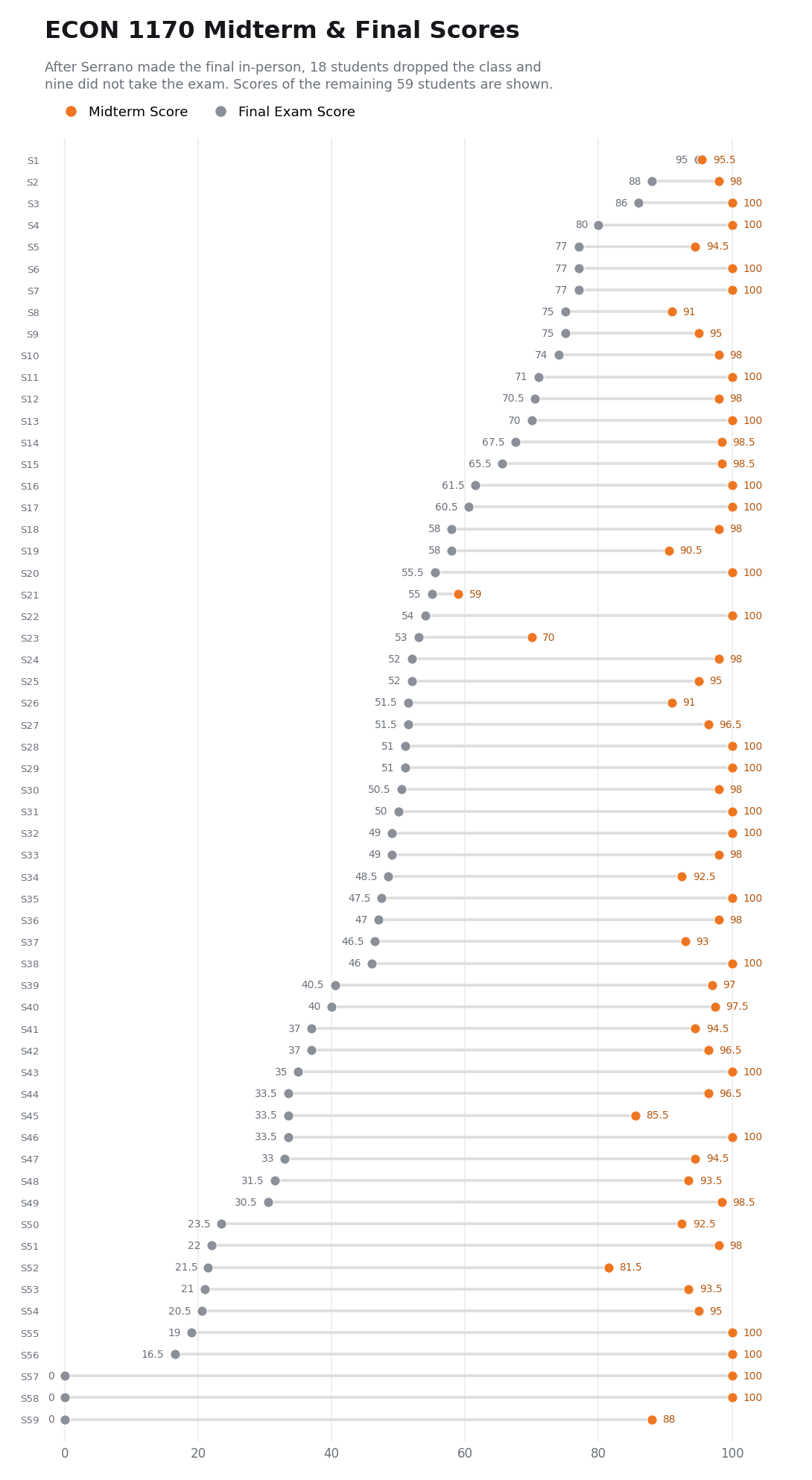
More than how absurd the midterm numbers are, what I actually care about is the final. The chart above, laying all 59 students' midterm (orange) and final (gray) scores side by side, tells the whole story. The dozen or so at the top scored between 70 and 95 on the final, not far off the course's historical 65-to-80 average, and their midterms were mostly above 90 too, consistent across both. What does that tell you? That the students who were genuinely prepared held up fine even with the tools gone and the exam moved in-person, turning in normal, even above-average scores. They didn't collapse.
What actually dragged the overall average down to 48 is the other cluster of dots: orange midterm marks hugging a perfect score, gray finals sinking into the 20s and 30s, a grotesquely long line stretched between them. The three most extreme cases scored between 88 and 100 on the midterm and a flat zero on the final. Flip it around, and the chart also shows a person or two whose midterms were only in the 50s or 60s to begin with and whose finals landed about the same, consistent front to back, obviously their own work. That's the whole distinction: the midterm was the entire class exploiting one obvious, unproctored, take-home loophole together, a predictable collective move; but the final was the last checkpoint, the rules spelled out, the stakes sitting right there in the open, and a group of people still chose to walk in and gamble. That's the part that's genuinely hard to defend, and the part actually worth examining.
The professor's handling isn't above criticism either
To be fair, Serrano's response wasn't flawless either. He started by moving the exam to take-home out of sympathy, then, on suspicion of cheating, flipped the final back to in-person and put the midterm grades themselves on the chopping block. The pivot is understandable, and to his credit he laid out his standard in advance: if the final diverged too far from the midterm, he'd revisit it. But turn it around, and an assessment method everyone had agreed to getting overturned wholesale after the fact, just because the results disappointed, means the students who genuinely didn't cheat and merely happened to pick this course are carrying a risk they didn't create. A decision born of consideration ended up a bet the whole class had to cover. That's the most awkward turn in the whole affair.
The real question isn't catching cheaters, it's how we assess
After this blew up, the recommendation from Brown's own generative-AI committee was to redesign how students are assessed. Harsher punishment did not make the list. That's a tacit admission that the unsolved problem sits deeper than whether these 86 students answered honestly, and the whole field still hasn't answered it: when an assignment can be done at home and AI happens to be especially good at it, what was it ever actually measuring, reasoning ability, or whether you can get a tool to hand something in for you?
So rather than treat this as some AI moral crisis, I lean toward seeing it as a very ordinary incentive-design problem: a course got stamped "easy," which drew in a crowd that wasn't there to learn, and that crowd happened to meet an assignment AI is especially good at handling, so the outcome was predictable. The part that genuinely surprised me is that smaller group, the ones still rolling the dice on a final they had no way left to escape.
Sources:
- Brown Professor Suspects Most of His Class Used AI to Cheat (Inside Higher Ed)
- 'Humanity has chosen to become idiots': This Brown professor switched to take-home exams after a mass shooting and discovered mass cheating (Fortune)
- "Massive Cheating" in Brown University Class, Alleges Professor (GoLocalProv)
- Brown University Professor Horrified to Discover Largest AI Cheating Scandal (Futurism)